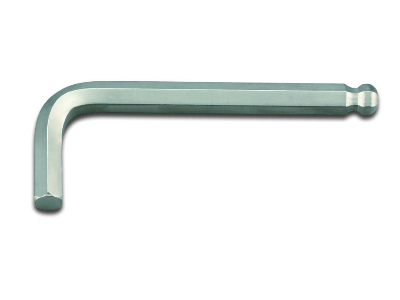
Quick answer: a ball-end hex key has a rounded tip that makes a single point of contact inside the fastener's hex socket, which lets you drive the fastener at an angle — commonly up to around 25° off the straight axis — but that point contact carries load over a much smaller area, so it is not meant for breaking loose or fully tightening a fastener. A straight hex key engages the full flat of the socket in line contact across all six faces, spreading load and letting you apply much higher torque with less risk of rounding the socket. As a hand tool manufacturer, our guidance is simple: start and finish with the straight end; use the ball end only for speed and angled access in between.
Point contact vs line contact: the core difference
A standard hex key is machined so its hexagonal cross-section matches the fastener's internal hex socket almost exactly. When you insert it straight in, all six flats of the key bear against all six inner faces of the socket — true line contact along the full depth of engagement. A ball-end hex key replaces the tip with a machined sphere. Off-axis, the ball can only touch the socket at a small number of points where the curved surface meets the flat walls, so the same torque is concentrated onto a much smaller contact area.
That difference in contact area is the entire story: line contact spreads force, point contact concentrates it. Everything else — torque capacity, angled access, and the risk of stripping — follows directly from that one geometric fact.
Comparison at a glance
| Ball-end hex key | Straight hex key | |
|---|---|---|
| Contact with socket | Point contact (rounded tip) | Full line contact (all six flats) |
| Angled access | Yes – typically up to about 25° off-axis | No – must be inserted straight |
| Torque capacity | Reduced – not rated for breakaway or final tightening torque | Full – rated for the fastener's specified torque |
| Risk of stripping the socket | Higher under load, especially at steep angles | Lower, when correctly sized and squarely inserted |
| Best use | Fast spin-on/spin-off, awkward angles, low-torque work | Breaking loose and final tightening, high-torque work |
When to use the ball end
The ball end earns its place on the bench for exactly the situations a straight key cannot handle: fasteners recessed behind a lip, set at an angle to the panel, or positioned where a straight key simply cannot line up with the socket axis. It also speeds up repetitive work — you can keep the key engaged and spin it in a wide circle to run a fastener in or out quickly, rather than repeatedly disengaging and re-indexing a straight key. This makes it the natural choice for the initial spin-in and the last few turns of spin-out, where torque is low and speed matters more than maximum grip.
Because the ball end's point contact cannot safely carry high torque, it should not be used for the final tightening pass or for breaking a stuck or corroded fastener loose. Doing so concentrates force on a small contact patch and increases the chance of rounding out the internal corners of the socket — a cam-out failure that is difficult to reverse and often means the fastener needs an extraction method to remove afterward.
When to use the straight end
Reach for the straight end whenever torque matters: initial breakaway of a tight or corroded fastener, and the final tightening pass to the fastener's specified torque. The full six-face engagement spreads load evenly around the socket, which both lets you apply more torque and reduces wear on the tool and the fastener over repeated use. On fasteners specified to a torque value (structural, safety-critical, or high-clamping-force joints), the straight end — or a torque wrench with a hex bit — is the correct tool; a ball end should not be used to hit a torque spec at all.
This is exactly why most L-shaped and T-handle hex keys are made with a ball end on one end and a straight end on the other, or a straight end only on tools intended purely for high-torque service: the two geometries are complementary, not competing, and a good technician switches between them within the same job.
Practical guidance for buyers and users
- Use the ball end for quick spin-in/spin-out and for fasteners you cannot approach squarely.
- Switch to the straight end before applying real torque, and always for the final tightening pass.
- Match the key size precisely to the fastener — an undersized key increases stripping risk regardless of which end you use, and this effect is worse on the ball end because the contact area is already reduced.
- Inspect for wear. A ball end that has been rounded further by misuse, or a straight end with worn corners, loses grip on both ends of the spectrum and should be retired.
Common mistakes that strip fasteners
Most hex-socket stripping comes down to a handful of avoidable habits. Using the ball end at a steep angle while forcing a stuck fastener is the most frequent cause, because the operator often cannot feel how little contact area is actually engaged until the socket has already started to round. Using a worn or slightly undersized key is a close second: a key that has lost its sharp corners, or that is one size too small for a metric/imperial mismatch, seats shallow in the socket and slips under load regardless of which end is used. Applying a cheater bar or extension to a hex key to gain leverage is a third common mistake — hex keys are sized for hand torque, and adding leverage on the ball end in particular can round the socket before the fastener even starts to turn.
Good hex keys are typically machined from alloy steel such as S2 or chrome-vanadium and heat treated for a balance of hardness (to hold the six-point profile) and toughness (to resist snapping under torque). The ball itself is precision-formed so its diameter and radius match the target socket size — a poorly formed or oversized ball reduces contact further and increases stripping risk even in the correct nominal size, which is one reason quality and calibration vary between suppliers even for the same labelled size.
Source Allen keys from the manufacturer
Transtime Tools manufactures both ball-end hex (Allen) keys for angled, fast-turning access and straight hex (Allen) keys built for full-torque tightening and breakaway work, in individual sizes and complete sets. If you are an importer, distributor, or industrial buyer and need size charts, material specifications, or OEM packaging, request a quote or contact our team — we can help you specify the right mix of ball-end and straight keys for your line.