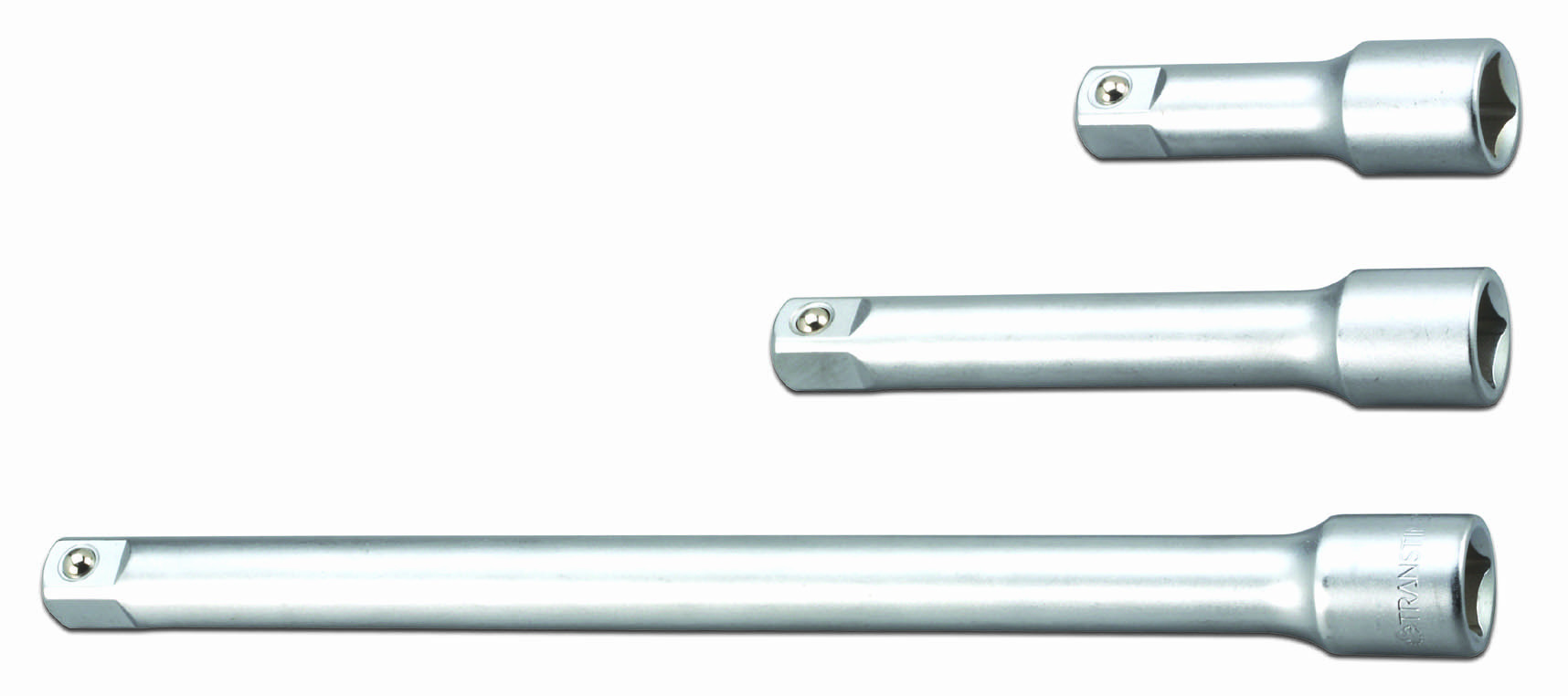
Quick answer: A wobble extension bar is a socket extension with a loose, spring-loaded ball joint at the drive end. Push a socket all the way onto it and it locks straight, working exactly like an ordinary extension bar. Pull the socket back a little way — a "half insert" — and the joint gains several degrees of swing, letting you reach a fastener that sits at an angle or is partly hidden behind an obstruction. It is a hand-tool accessory: standard chrome wobble extensions are made for ratchets and breaker bars, not for impact wrenches, which need their own impact-rated (and usually non-wobble) extensions.
What is a wobble extension bar?
A wobble extension looks like an ordinary square-drive extension bar, but the drive end is a ball-and-socket joint rather than a fixed square. A spring-loaded pin holds a socket on with some side clearance instead of a rigid, square-on-square fit. That small amount of built-in play is what lets the far end tilt relative to the extension's axis, so the socket can meet a fastener that is not perfectly in line with the tool.
Half insert vs full insert: two tools in one
The practical trick to using a wobble extension is how far you push the socket on:
- Fully seated (full insert): the socket locks square onto the drive end, and the wobble joint is taken up. The extension behaves like a normal rigid extension bar — full engagement, no play, suitable for turning a fastener straight-on.
- Partially seated (half insert): the socket sits on the ball joint without locking flat, giving it several degrees of swing — commonly cited around 15° of angle at each joint, and more on some multi-joint wobble sets. This is what lets you start a fastener that you can only approach from an angle, or walk a socket onto a bolt head that a straight extension cannot line up with.
In other words, one tool covers both jobs: push the socket all the way on for normal straight-line work, and pull it back slightly whenever access forces you off-axis.
When a wobble extension earns its keep
Reach for a wobble extension when a fastener is obstructed or angled and a straight extension simply cannot line up with it — for example, bolts tucked behind brackets, valve covers, or manifolds, fasteners inside a wheel well or engine bay at an awkward angle, or the last turns of a bolt in a recessed pocket where you need to tip the socket slightly to clear the sides. It is a "get me started or get me the last few degrees" tool as much as a general extension — many mechanics keep a short wobble extension in the set specifically for the one bolt a straight extension won't reach.
Why you should not use a standard wobble extension with an impact wrench
This is the point most often missed, and it matters for safety. Ordinary hand-tool extensions — including wobble extensions — are typically chrome-plated and heat treated for the smooth, steady torque of a hand ratchet or breaker bar. An impact wrench does not apply smooth torque; it delivers rapid hammer-like rotational blows. A standard chrome extension used on an impact wrench absorbs that hammering poorly and can crack or shatter, and a wobble joint adds a second failure point (the ball joint itself) that is not built for repeated shock loading. Impact-rated extensions are made from tougher chrome-molybdenum steel, heat treated specifically to absorb impact energy, and are usually built as plain (non-wobble) bars for that reason — the joint that makes a wobble extension flexible is also the part least suited to repeated hammering. If your job needs both an extension and an impact wrench, use a dedicated impact extension bar rather than a hand-tool wobble extension.
Drive sizes and typical lengths
Wobble extensions are made across the common hand-tool drive sizes, in the same length steps as standard extension bars for that drive:
| Drive size | Typical lengths | Notes |
|---|---|---|
| 1/4" | 2" to 9" | For small fasteners in tight, awkward spots — electronics enclosures, small brackets |
| 3/8" | 3" to 10" | The most common size for general automotive and light industrial work |
| 1/2" | 3" to 10" | For heavier fasteners where access is still restricted, e.g. suspension and drivetrain work |
Transtime Tools manufactures wobble extension bars across all three drive sizes alongside our standard (non-wobble) extensions, sliding T-bars, and universal joints — see the 1/4" drive accessories, 3/8" drive accessories, and 1/2" drive accessories ranges for full item numbers and dimensions.
Wobble extension vs universal joint — which to choose
Both tools solve an angled-access problem, but differently. A universal joint (U-joint) pivots freely through a wide range of angles and is the better choice when you need to drive at a sharp, fixed angle — for example straight through a hole in a bracket. A wobble extension gives a smaller, more controlled amount of play concentrated at one joint, which is usually enough to walk a socket onto a slightly misaligned fastener and then tighten it, and it locks rigid when fully seated, which a U-joint does not. Many toolkits carry both: a U-joint for genuine right-angle or steep-angle access, and a wobble extension for the more common case of a fastener that is just slightly off-line.
Buying and sourcing checklist
When specifying wobble extensions, confirm: drive size (1/4", 3/8", 1/2", or larger), length, whether the tool is rated for hand use or impact use (do not assume — ask), and the base alloy and finish (chrome-plated Cr-V for hand tools; black-oxide or phosphate-coated Cr-Mo for impact-rated accessories). Matching the right accessory to the right drive tool avoids both wasted torque and the safety risk of overstressing a part that was never designed for it.
Source wobble extensions from the manufacturer
Transtime Tools forges and heat treats hand-tool wobble extension bars in 1/4", 3/8", and 1/2" drive, alongside a full line of impact-rated extensions and accessories for power tool use. Browse our 1/2" drive accessories for the standard wobble extension range, or if your application needs an impact-rated bar instead, see our 1/2" drive impact accessories. If you are an importer, distributor, or industrial buyer and need item numbers, dimensions, or OEM options, request a quote or contact our team.