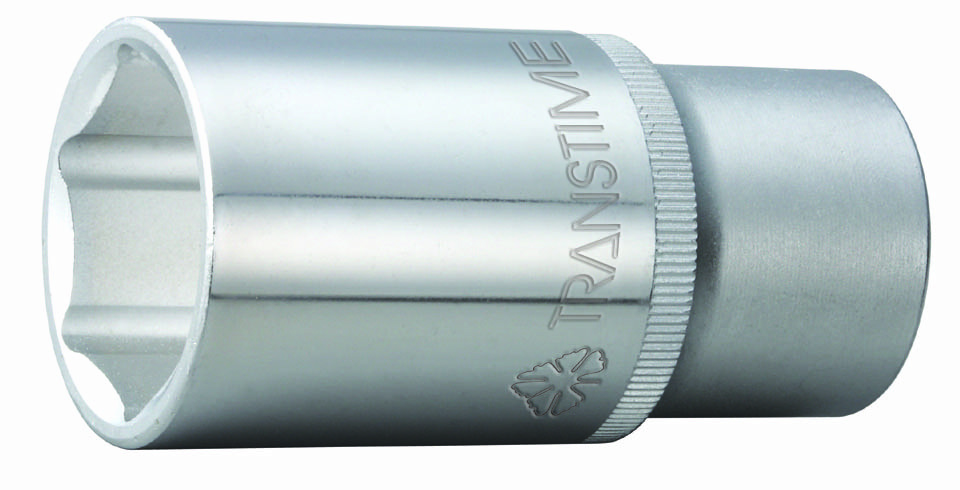
Quick answer: Chrome plating, black oxide, and phosphate coatings all protect tool steel, but they do it in different ways and for different jobs. Chrome plating is an electroplated hard layer that gives the best corrosion resistance and the brightest, most premium look while it stays intact, but it is a thin, relatively brittle shell that can chip or flake under shock. Black oxide is an ultra-thin chemical conversion coating prized for a uniform matte-black look and tight tolerances, but it only resists rust meaningfully when kept oiled. Phosphate coating — usually manganese or zinc phosphate — is thicker and porous, so it holds oil deep in its surface and is the finish of choice for parts under repeated friction and mechanical stress, which is exactly why most impact sockets wear a black phosphate finish rather than chrome. As a manufacturer, the finish we specify for a part is a functional decision, not just a cosmetic one.
What each finish actually is
Chrome plating is electroplating: the tool is submerged in a chromium solution and a thin, hard layer of chromium metal is deposited over the base steel using an electric current. It is worth separating this from "chrome vanadium" or "chrome molybdenum" steel — those names describe the alloy the tool is forged from, while chrome plating is a separate finishing step applied afterward, and not every chrome-alloy tool is chrome plated.
Black oxide is a chemical conversion coating, not a plated layer. The part is treated in a hot alkaline oxidizing bath that converts the surface of the steel itself into black magnetite (Fe₃O₄). Because nothing is deposited on top of the steel, the layer is extremely thin — commonly well under two microns — which is why black oxide barely affects a part's dimensions.
Phosphate coating is also a conversion coating, but a much thicker and rougher one: the part is immersed in a phosphoric-acid-based bath that grows a crystalline layer of zinc or manganese phosphate on the surface, typically in the range of several microns up to around 25–40 microns for the heavier manganese phosphate finishes used on tooling. That crystalline structure is naturally porous, which is the property that makes it useful.
Corrosion resistance compared
Chrome plating gives the strongest standalone corrosion resistance of the three: a fully intact chrome layer seals the steel underneath very effectively. The catch is that seal — once the plating is chipped, cracked, or worn through, the exposed steel beneath can rust, and because chrome plating is a relatively hard, brittle shell, impact or heavy shock loading is exactly the kind of stress that can crack it. Black oxide on its own offers only modest protection; industry sources are consistent that it needs a follow-up coat of oil, wax, or another sealant to hold up in a working environment, and without that maintenance it will rust. Phosphate coatings sit in between structurally but pull ahead functionally: their porous crystalline surface is designed to soak up and retain oil, and a properly oiled phosphate coating — manganese phosphate especially — is reported to perform very well under harsh, high-friction conditions, which is why it remains the standard finish on components that see continuous mechanical stress.
Friction, lubrication, and wear — why impact sockets are phosphate, not chrome
This is where the three finishes diverge most in practice. Chrome plating is smooth and largely non-porous, so it does not hold oil in the surface the way a phosphate coating does, and its hardness gives it little ability to flex under a sudden shock — which is exactly what an impact wrench delivers. Black oxide is also thin and offers no real friction-reducing benefit on its own. Phosphate coatings, and manganese phosphate in particular, are formulated for the opposite situation: the porous crystalline layer draws in oil and holds it, cutting friction and resisting galling on parts subjected to repeated mechanical loading. That combination — durable under shock, and better at retaining a protective film of oil in service — is why impact sockets and other high-cycle industrial tooling are finished in black phosphate or black oxide rather than bright chrome, and why a socket's dark, matte finish is generally a practical (though not the only) signal that it is built for impact use rather than hand-driven torque.
Appearance and cost
Chrome plating is the most visually premium finish — bright, reflective, and easy to spot in a dim toolbox or under a vehicle — but the extra electroplating steps make it the most expensive of the three to apply. Black oxide gives a uniform, understated matte black finish at a low processing cost, which is one reason it also shows up on precision instruments and fasteners where tight tolerances matter. Phosphate coatings have a duller, more crystalline gray-to-black texture that is purely functional rather than decorative, with manganese phosphate generally costing more to apply than zinc phosphate in exchange for better wear performance.
Finishes compared at a glance
| Finish | Typical thickness | Corrosion resistance | Friction / oil retention | Typical tool use |
|---|---|---|---|---|
| Chrome plating | Thin, hard electroplated layer | Very good while intact; vulnerable once chipped | Low — smooth, non-porous surface | Hand wrenches, hand sockets, ratchets |
| Black oxide | Ultra-thin (well under 2 microns) | Modest alone; needs oil to hold up | Low, unless oiled | Precision parts, fasteners, some impact accessories |
| Zinc phosphate | Several microns | Moderate to good with oil | Moderate | General fasteners, light-duty hardware |
| Manganese phosphate | Heavier, up to ~25–40 microns | Good with oil, especially under load | High — designed to hold oil under friction | Impact sockets, high-cycle industrial tooling |
Which finish for which job
None of these finishes is universally "better" — each is matched to how the part is actually used. If a tool is hand-driven, inspected by eye, and needs to look premium and resist casual corrosion, chrome plating is the traditional choice. If a part needs tight tolerances and a clean look at low cost, black oxide is a sensible fit, provided it is kept oiled in service. If a part is going to see repeated mechanical stress, friction, or shock loading — the situation an impact socket is built for — a phosphate finish, typically manganese phosphate, is the more durable and functional choice, which is also why it pairs naturally with the tougher Cr-Mo alloy those sockets are forged from.
Transtime Tools finishes hand tools and impact accessories with the coating appropriate to each product line, backed by our in-house forging and heat-treatment process. See how our tools are made on our manufacturing capabilities page, browse our full product range to compare finishes across our socket and wrench lines, or request a quote and contact our team if you need finish specifications or certificates for a sourcing decision.