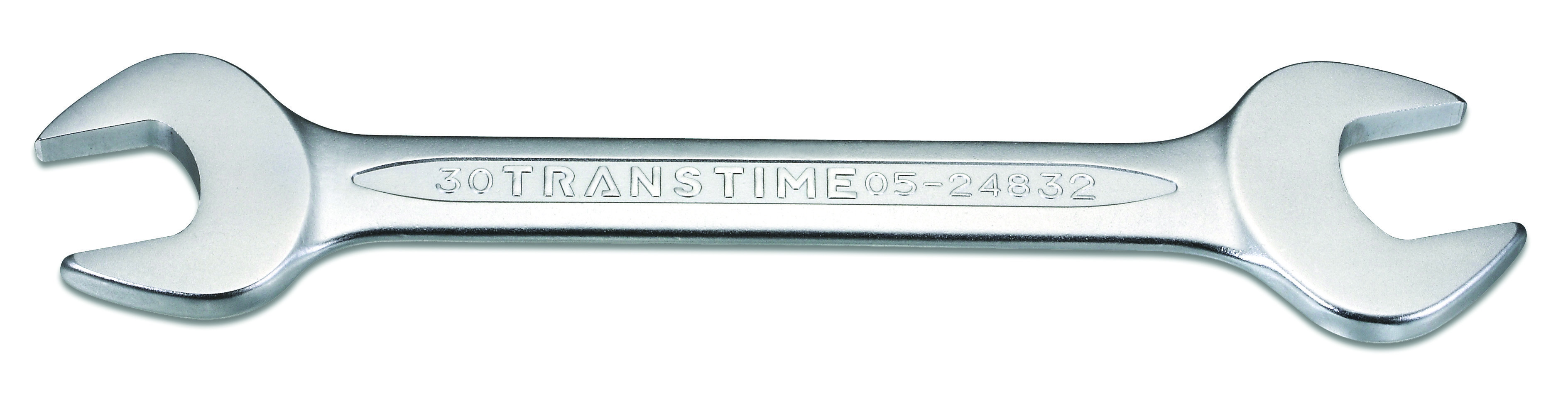
A flare nut wrench — also called a line wrench, tube wrench, or fitting wrench — is an open-end style wrench with a nearly closed jaw that wraps around five or six sides of a hexagonal flare nut, leaving just enough of a slot to slide over the tubing that runs through it. It is the standard tool for brake lines, fuel lines, and other soft or thin-walled tube fittings, because it spreads the driving load across most of the nut's flats instead of the two flats a plain open-end wrench grips — which is what keeps a flare nut from rounding off. This guide covers how a flare nut wrench differs from an open-end wrench, the DIN 3118 standard most metric flare nut wrenches follow, and when to use one. As a manufacturer of wrenches, our aim is to help you specify the right tool for tube fittings.
What is a flare nut wrench?
A flare nut wrench's head is closed around most of its circumference, unlike the open "U" of a standard open-end wrench. Only a narrow slot is left open — just wide enough to let the wrench slip sideways onto the tubing and over the nut, rather than needing to be threaded on from the end. Depending on size, the jaw profile is either hexagonal (6-point, contacting all six corners) or bi-hexagonal (12-point), and the tool is almost always double-ended, with a different size opening at each end of the handle.
Flare nut wrench vs. open-end wrench
A standard open-end wrench only touches two opposite flats of a hex nut. On a thick steel bolt that is often enough contact area to apply real torque without harm. A flare nut, however, is thinner-walled and, on many fittings — refrigerant lines, fuel lines, and some hydraulic and brake fittings — made from a softer metal such as brass, copper, or aluminum rather than plain steel. On these fittings, two-point contact concentrates load onto two corners and rounds them off quickly, especially on a nut that is corroded, over-torqued, or being loosened for the first time in years. A flare nut wrench wraps around five (or effectively all six, with a 6-point or 12-point profile) of the flats, distributing the same torque over far more contact area and cutting the risk of rounding the fitting.
The DIN 3118 standard
Most metric flare nut wrenches are made to the German DIN 3118 standard, which sets the jaw geometry, angle, and typical size range so tools from different makers stay broadly interchangeable.
| Feature | Typical DIN 3118 spec |
|---|---|
| Jaw / head angle | 15° open ring angle, 15° head offset |
| Profile | Hexagonal (6-point) up to about 12×14 mm; bi-hexagonal (12-point) above that |
| Material | Chrome-vanadium steel, typically satin-chrome finished |
| Common metric sizes | From about 8×10 mm up to 30×32 mm, double-ended |
Because each wrench is double-ended with two different jaw sizes, one tool covers two common fitting sizes, which is why most sets are sold as a handful of double-ended wrenches rather than a long single-size range.
Where flare nut wrenches are used
Flare nut wrenches are best known as brake line and fuel line tools in automotive work, where rounding off a steel or brass tube nut can mean a damaged, leaking, or unrepairable fitting. The same reasoning applies to refrigerant and air-conditioning line fittings, hydraulic tube connections, and any other flared or compression fitting made from a relatively soft metal where a standard open-end or adjustable wrench risks slipping and rounding the nut.
Choosing the right size
Flare nut wrenches are sized the same way as ordinary wrenches, across the flats of the nut, in millimeters or fractional inches, so match the size to the fitting exactly rather than rounding up or down to the nearest wrench you have on hand. Because most fittings on a given vehicle or system use only a handful of sizes, a set of double-ended wrenches covering roughly 6 mm to 22 mm (or about 1/4" to 7/8" in inch sizes) covers the great majority of passenger-vehicle brake, fuel, and AC line work; larger sizes exist for bigger hydraulic and industrial tube fittings.
Using a flare nut wrench correctly
To get the benefit of the closed jaw, slide the wrench onto the tubing before it reaches the nut rather than trying to thread it on from the end, and push it fully onto the fitting so all five or six flats are engaged before applying force. On a fitting that has not moved in years, working penetrating oil into the threads first and breaking it loose with steady, even pressure — rather than a sharp jerk — reduces the chance of rounding it even with the correct wrench. If the fitting still will not turn, the flare nut wrench is the tool to keep working with; switching to pliers or an adjustable wrench at that point is what typically ends up destroying the fitting.
Why not use an adjustable wrench instead?
An adjustable (crescent-type) wrench relies on two flat jaws squeezing the nut, and on a worn or loosely adjusted wrench those jaws can rock or slip under load. On a soft flare nut, that slip is exactly what rounds off the corners, and an adjustable wrench also cannot slide onto the tubing the way a flare nut wrench can — its jaw has to open at the end of the fitting, which is often blocked by other lines or components. A correctly sized flare nut wrench avoids both problems.
Flare nut, crowfoot, and ratcheting variants
Beyond the standard double-ended flare nut wrench, the same closed-jaw profile is also made as a crowfoot head for use with a ratchet or torque wrench in confined spaces, and as a ratcheting flare nut wrench that lets you index the fastener without lifting the tool off between strokes. These variants are useful where clearance around the fitting is too tight to swing a standard wrench handle, but the plain double-ended wrench remains the most common and lowest-cost option for routine brake and fuel line work.
Source flare nut wrenches from the manufacturer
Transtime Tools manufactures open-end, box-end, and offset ring wrenches to DIN and other international standards, and we produce flare nut wrenches to DIN 3118 as an OEM/ODM item on request. Browse our wrenches range for the profiles we carry as standard, and contact our team to discuss flare nut wrench specifications, sizes, and private-label production.