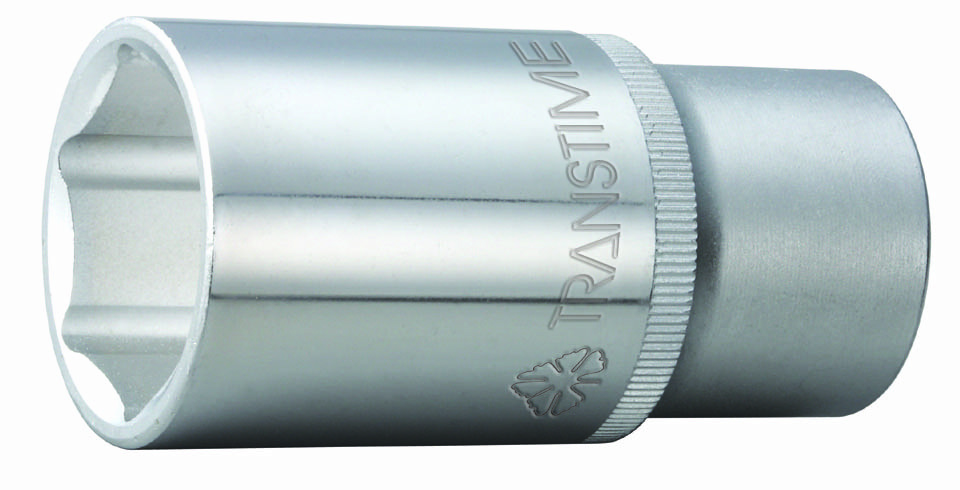
DIN 3120/3121 (paralleled internationally by ISO 2725-1/-2) and ANSI/ASME B107 (formerly B107.1, now consolidated into B107.110) both standardize the dimensions of hand and impact sockets and their square drives, but they are not the same specification under two names. The practical differences are the unit system each is written in, how the size series is organized, and — most importantly for fit — the dimensional tolerance each allows on the hex or drive opening. A socket built to one standard is not automatically dimensionally identical to a socket of the “same” nominal size built to the other.
What DIN 3120/3121 and ISO 2725 Cover
DIN 3120, “Driving squares for hand-operated socket wrenches,” and DIN 3121, “Driving squares for machine-operated socket wrenches,” are German national standards that define the square drive stub on hand and impact sockets — the part that mates with a ratchet, breaker bar, or impact wrench anvil. They are closely paralleled internationally by ISO 2725-1 (hand-operated square drive sockets) and ISO 2725-2 (machine-operated “impact” square drive sockets), which specify the dimensions, designation, and marking of the sockets themselves. Because the DIN and ISO documents were developed in coordination, tools built to either are generally treated as interchangeable across European and Asian metric markets.
What ANSI/ASME B107 Covers
ASME B107.1, “Socket Wrenches, Hand (Inch Series),” was the U.S. standard covering general and dimensional data for detachable, hand-operated socket wrenches with square drive, plus the test methods used to verify them. It has since been folded into the broader ASME B107.110, “Socket Wrenches, Handles, and Attachments,” which covers performance and safety requirements for sockets, handles, nutdrivers, and attachments in a single document. ASME B107 is the reference North American buyers and distributors expect to see cited on inch-series (SAE) sockets.
Where the Two Standards Actually Diverge
| Aspect | DIN 3120/3121 & ISO 2725 | ANSI/ASME B107 |
|---|---|---|
| Primary unit basis | Millimeters | Inch (fractional) series, with metric variants also produced |
| Home market | Germany, harmonized internationally via ISO | United States / North America |
| Square drive scope | Split by use: DIN 3120 (hand-operated), DIN 3121 (machine-operated/impact) | Historically split similarly across the B107 series; now consolidated under B107.110 |
| Dimensional tolerance | Tighter tolerance band on the hex/drive opening at a given nominal size, per industry comparisons | Wider tolerance band allowed at the same nominal size, per the same comparisons |
On the tolerance point specifically: a published comparison from a Taiwanese socket manufacturer cites a 1/2″ drive socket hex opening toleranced to within 0.11 mm under DIN versus 0.218 mm under the equivalent ASTM/ASME figure — roughly double. That figure comes from an industry technical comparison rather than a direct quotation of the standards documents themselves (both are paywalled by DIN and ASME), but it illustrates the pattern buyers should expect: DIN/ISO tooling is commonly built to a tighter dimensional band than the ANSI/ASME equivalent at the same nominal size, which affects fastener fit, material usage, and machining setup.
Does This Matter for Buyers and Importers?
Square drive nominal sizes — 1/4″, 3/8″, 1/2″, 3/4″, 1″ and larger — are consistent across DIN, ISO, and ANSI/ASME, so a ratchet built to one standard will physically accept a socket built to another at the same nominal drive size. What is not guaranteed is that the hex bore of a socket stamped to one standard will grip a fastener head machined to the other standard's tolerance with the same precision, particularly on worn or corroded fasteners. For everyday workshop use the difference is rarely noticeable; for calibrated torque work, tight OEM tolerances, or a private-label program sold into a specific regulatory market, it is worth confirming which standard you need at the quoting stage.
How Transtime Tools Builds to Both
As an ISO 9001 certified manufacturer, we produce sockets and wrenches to DIN 3120/3121, ISO 2725, and ANSI/ASME B107 depending on the destination market and the customer's specification — see our standards and compliance page for the full list of standards we build to. Tell us which standard your market requires and we will confirm what we can support for your order.
Shop DIN- and ANSI-Spec Sockets
We manufacture both metric and inch (SAE) hand sockets and impact sockets across the full drive-size range. For a specific standard, private-label packaging, or custom tolerance requirements, contact our team.