Quick answer: No — a standard chrome-plated hand socket should never be run on an impact wrench. Hand sockets are typically forged from chrome vanadium (Cr-V) steel and heat treated toward the harder end of the useful hardness range so they hold their dimensions under steady hand torque; that same hardness makes them relatively brittle. An impact wrench does not apply smooth, steady torque — it delivers rapid rotational hammer blows, thousands of short shock pulses a minute — and a hard, thin-walled chrome socket is not built to absorb that kind of repeated shock. Under it, a chrome socket is prone to cracking or shattering outright rather than bending, which can throw metal fragments toward the operator's hands, face, or nearby equipment. Impact-rated sockets exist specifically to solve this: they are made from chrome molybdenum (Cr-Mo) steel, tempered tougher, built with thicker walls, and finished in black oxide or phosphate rather than bright chrome. Matching the socket to the tool is a basic safety step, not a fine point.
Hand torque and impact-wrench loading are not the same kind of stress
A person turning a hand ratchet or breaker bar applies a relatively smooth, steadily rising torque, and the operator's own arm acts as a natural limit and feedback mechanism — you feel a fastener getting harder to turn and can stop. An impact wrench works completely differently: an internal hammer mechanism strikes a rotating anvil in rapid, repeated bursts, delivering short, very high peak-stress shocks to whatever socket is attached, over and over, with no direct feedback to the operator about how hard each individual blow lands on the socket wall. A socket has to survive that repeated hammering, not just a single steady twist, and that is a fundamentally different engineering problem from holding up under hand torque.
Why a chrome hand socket is built for the wrong kind of stress
Hand sockets are generally forged from Cr-V steel and tempered toward the harder end of the range used for hand tools, because that hardness helps a socket hold precise internal dimensions and resist wear and rounding under steady torque — and it takes a bright chrome plating well, which is part of why these sockets are shiny. We go into the hardness trade-off itself in our guide to tool hardness (HRC) explained: put simply, harder also means less able to flex, and a hand socket's wall is generally thinner than an impact socket's because it was never designed to absorb hammer-blow shock in the first place. Put a hard, thinner-walled, chrome-plated hand socket under the repeated impact loading of a power tool, and the same hardness that makes it a good hand tool becomes a liability.
What actually happens when a chrome socket fails under impact
Because the failure mode is brittle rather than ductile, a chrome socket under repeated impact loading tends not to bend or wear down gradually the way a softer, tougher part would — it cracks and can shatter suddenly, without much warning. The chrome plating itself can also chip and flake off under the hammering, and a chip in a hard plated surface can act as a starting point for a crack to grow from. The practical safety concern is straightforward: fragments from a socket that shatters under power can be thrown with real force toward the operator's hands or face, or toward anyone standing nearby, which is why tool manufacturers and safety guides are consistent in warning against this combination rather than treating it as a minor durability issue. Normal precautions — eye protection when running any power tool, and simply using the correct-rated socket — remove this risk entirely.
What makes an impact-rated socket different
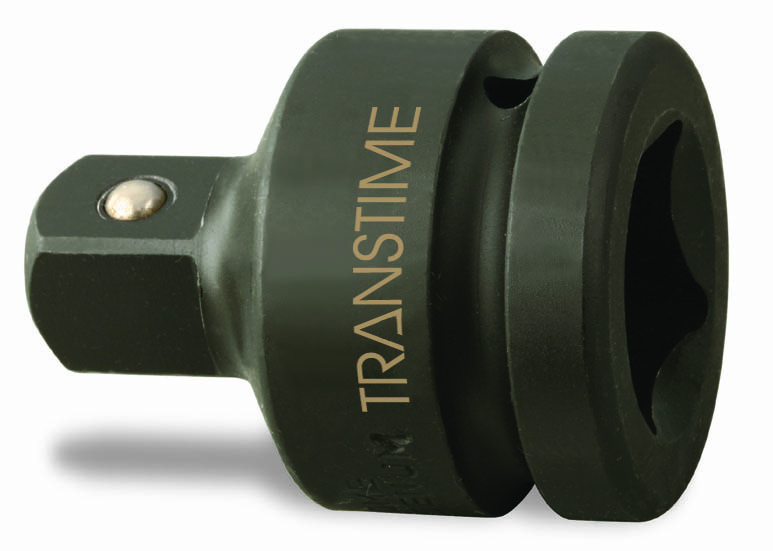
Impact sockets solve this by changing the alloy, the temper, and the geometry together, not just the finish. They are forged from chrome molybdenum steel, which responds to heat treatment with more retained toughness at a working hardness, and they are deliberately tempered toward the tougher, somewhat lower-hardness end of the impact-socket range rather than the hardest number the steel can reach — the goal is a socket that can flex slightly and absorb a blow instead of cracking. They are also typically built with thicker walls than an equivalent hand socket, giving the material more cross-section to spread each shock across, and finished in black oxide or manganese phosphate instead of chrome, since a hard chrome plating tends to chip and flake under the same hammering the socket itself is designed to survive. That matte black finish also happens to make an impact socket easy to identify at a glance.
How to tell them apart before you reach for one
In practice, the color and finish of a socket is a useful first signal — bright chrome generally means a hand-driven socket, and a matte black finish generally means it is built for impact use — because chrome-plated impact-rated sockets are not a normal product in the market; the plating simply does not hold up to impact loading, so manufacturers do not build impact sockets that way. That said, appearance is a helpful cue, not a certified spec: the reliable way to confirm a socket is impact-rated is to check its packaging or markings, since color alone should never override what the manufacturer actually states the part is rated for.
Chrome hand socket vs impact-rated socket
| Property | Chrome hand socket | Impact-rated socket |
|---|---|---|
| Typical alloy | Chrome vanadium (Cr-V) | Chrome molybdenum (Cr-Mo) |
| Heat-treatment emphasis | Harder, for precision and wear resistance | Tougher, for shock absorption |
| Typical wall thickness | Thinner | Thicker |
| Typical finish | Bright chrome plating | Black oxide or manganese phosphate |
| Rated for impact wrench use | No | Yes |
Source impact-rated sockets from the manufacturer
Transtime Tools forges impact sockets and accessories in-house from Cr-Mo alloy steel, heat treated and finished specifically for power-tool use rather than adapted from a hand-tool line. You can browse our full impact sockets & socket sets range, see our forging and heat-treatment process on our manufacturing capabilities page, or request a quote and contact our team if you need impact-rating documentation or certificates for a bulk or private-label order.